
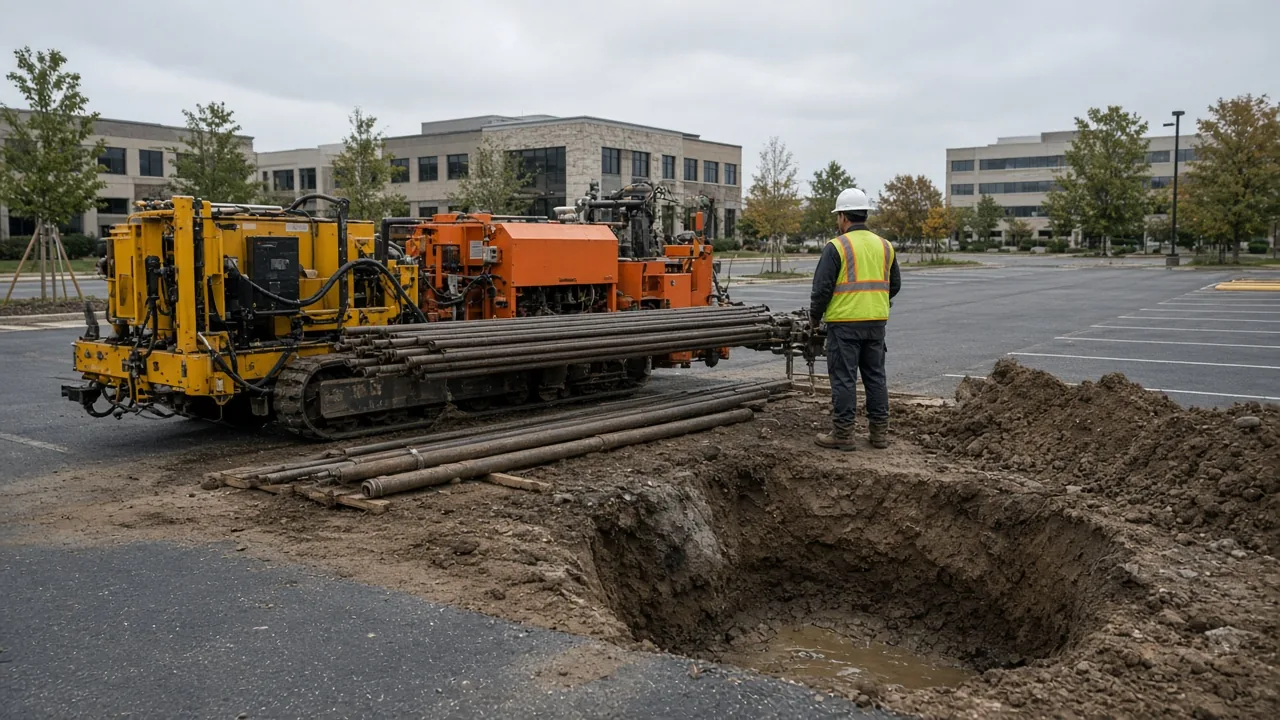
Property owners and contractors hear that horizontal directional drilling can install an underground pathway without cutting a long trench. The method is clear once you walk through the steps: locate what is already buried, set pits at each end, steer a bore between them, and pull new conduit back through the hole. That sequence is what most people mean when they ask how directional drilling works on a real site in Schaumburg or elsewhere in the Chicago suburbs.
What directional drilling is for
Directional drilling, also called directional boring work or horizontal bore drilling, creates a guided underground path for pipe or conduit. The surface between the start and end points stays in place except for the small pits the crew needs. That is why it is a common choice under parking lots, drives, sidewalks, and finished landscaping when an open trench would shut the property down or force a large restoration.
A&P Directional Drilling installs the underground pathway. Electrical terminations, gas tie-ins, and other utility connections stay with the trades that own that work. The bore is the path; the product pulled through it depends on the project.
Step 1: Locate utilities and plan the bore path
Before any rod goes in the ground, existing utilities have to be marked. Gas, water, electric, fiber, and drainage can sit in the same corridor the new run needs. The plan sets entry and exit pits, the target depth, and the curve the bore can make without conflicting with those lines. A tight commercial lot in Schaumburg is a different setup than an open yard behind a warehouse, even when the pipe size is the same.
Soil matters too. Clay, fill, rubble, and wet sand change how the head tracks and how much fluid the bore needs. The crew adjusts depth and steering so the path stays controllable from pit to pit.
Step 2: Drill the pilot bore
The rig sits at the entry pit and pushes a steerable drill head along the planned path. A transmitter in the head, read from the surface, shows depth and direction so the operator can correct as the bore advances. The pilot hole is smaller than the final conduit. Its job is to prove the route before the hole is enlarged.
On longer runs the crew adds drill rods as the head moves forward. The machine stays at the entry; the progress is underground. That is the core of how directional drilling works in practice: the surface between the pits is not opened while the path is built.
Step 3: Ream and pull the conduit
Once the pilot reaches the exit pit, a reamer enlarges the hole to the size the conduit needs. New conduit or pipe is attached and pulled back toward the entry as the reamer comes through. The result is a continuous underground pathway ready for underground electrical conduit, drainage, communications, or other products the job specifies.
Horizontal directional drilling services stop at the pathway. Pulling conductors, making up gas connections, and restoring any pits or surface patches follow the scope agreed with the general contractor or property owner.
When boring fits better than an open trench
Boring wins when the surface has to stay in service: a parking aisle that cannot close, a landscaped front yard, or a crossing under pavement. Open trenching still makes sense on short runs in already open ground, or when utilities are too shallow and crowded for a safe bore. The tradeoffs are covered in horizontal directional drilling versus open trenching.
Failed conduit under a parking lot is a typical case where a new bored pathway restores service without rebuilding the asphalt. That situation is described in why a light pole stopped working.
What to ask before the crew mobilizes
Confirm what product goes in the hole, who owns the electrical or gas work at each end, and how much room the site has for the rig and the pits. Ask whether the run crosses pavement, landscaping, or both, and whether other utilities have already been located. Clear answers on those points keep directional boring work on schedule and keep the surface disruption limited to what the method is meant to avoid.
Need a directional drilling or conduit pathway?
Call us or tell us about the project and we will follow up with a free estimate.