Property owners and contractors in Chicago and the Illinois suburbs usually face the same choice when a new utility has to go in: cut the ground open, or bore under it. Both methods can install conduit. They do not cost the same, they do not leave the site the same, and they are not interchangeable on every lot.
What each method actually does
Open trenching excavates a continuous slot from one end of the run to the other. The crew lays the pipe, backfills, and then restores whatever was on top — lawn, gravel, asphalt, or concrete. It is direct. You can see the pipe the whole way. It is also a long scar if the run crosses a drive, a parking aisle, or a finished yard.
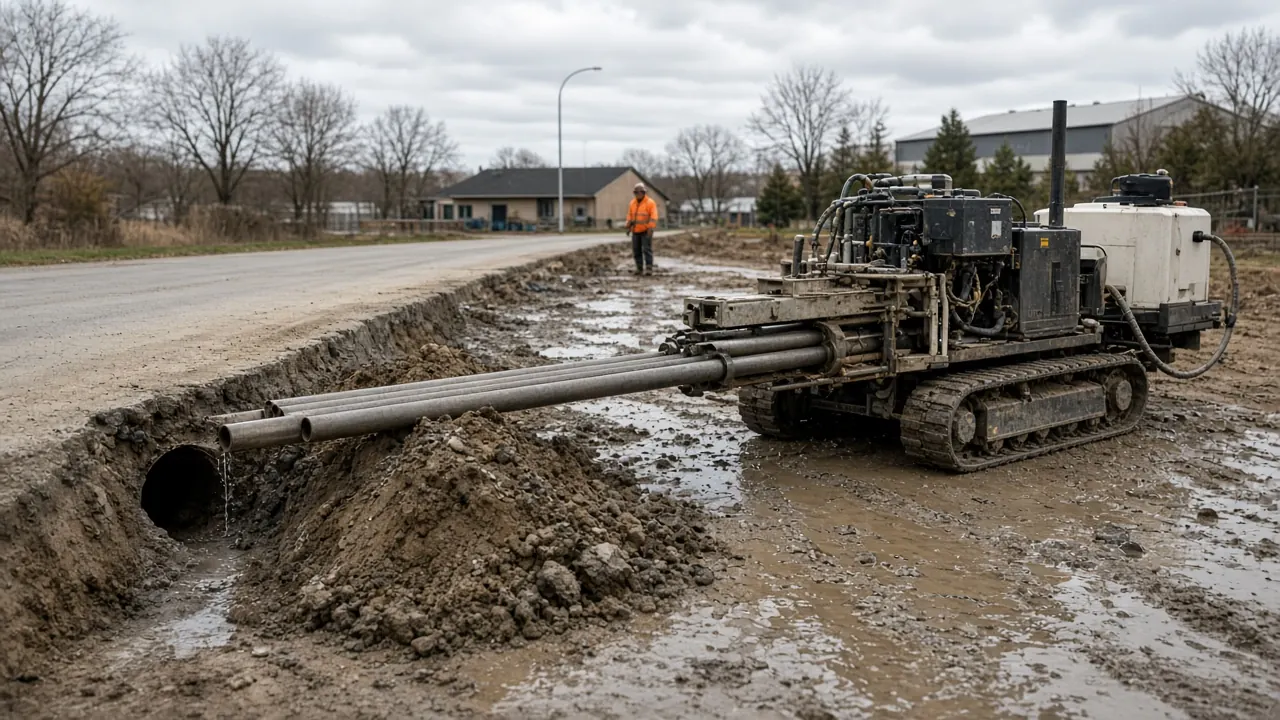
Horizontal directional drilling starts and ends at pits. The rig bores a steered path between them and pulls conduit back through the hole. The surface between the pits stays in place. That is why boring is the usual request for underground electrical conduit, drainage crossings, and other pathways under pavement around Chicago and nearby suburbs.
Surface, access, and what the site can spare
Open trench wins when the ground is already open, the run is short, and restoring the surface is cheap. A new building pad, a wide landscape bed, or a gravel yard often fits that description. The trench is simple to inspect, and other trades can see the pipe before it is covered.
Boring wins when the surface has to stay in service. A store that cannot close a drive aisle, a homeowner who does not want the lawn cut from the house to the pole, or a road crossing that cannot be saw-cut for a day are typical cases. The drill still needs room for the rig, the rods, and the pits. A site with no place to set up is not a boring site, even if the owner would rather not see a trench.
Soil, utilities, and depth
Chicago-area ground is not one soil. Clay, fill, rubble, and wet sand change how a bore tracks and how a trench holds its walls. Existing gas, water, electric, and communications have to be located either way. A bore that must weave between those lines needs a path and a depth the locator can support. A trench in the same corridor may be the safer choice if the utilities are shallow and crowded.
Depth is the other split. A trench gets expensive as it gets deep, because the cut gets wide and the restoration grows with it. A bore can stay deeper under a road or a creek without opening that surface. It cannot make a sharp turn the way a person with a shovel can. If the route has several tight corners, the plan may mix a bore on the long crossing with short open sections at the ends.
How to choose for a real project
Ask three questions. What is on the surface, and can it be rebuilt without shutting the property down? How long is the run, and what else is already buried there? Who is responsible for the pipe versus the wire or the product that goes inside it? A&P Directional Drilling installs the underground pathway. Electrical terminations, gas tie-ins, and final utility connections stay with the trades that own that work.
For a dark light pole, the failed piece is often the conduit itself. That situation is described in why a light pole stopped working. Whether the fix is a bore or a short open repair depends on how much pavement sits over the bad section.
Need a directional drilling or conduit pathway?
Call us or tell us about the project and we will follow up with a free estimate.