
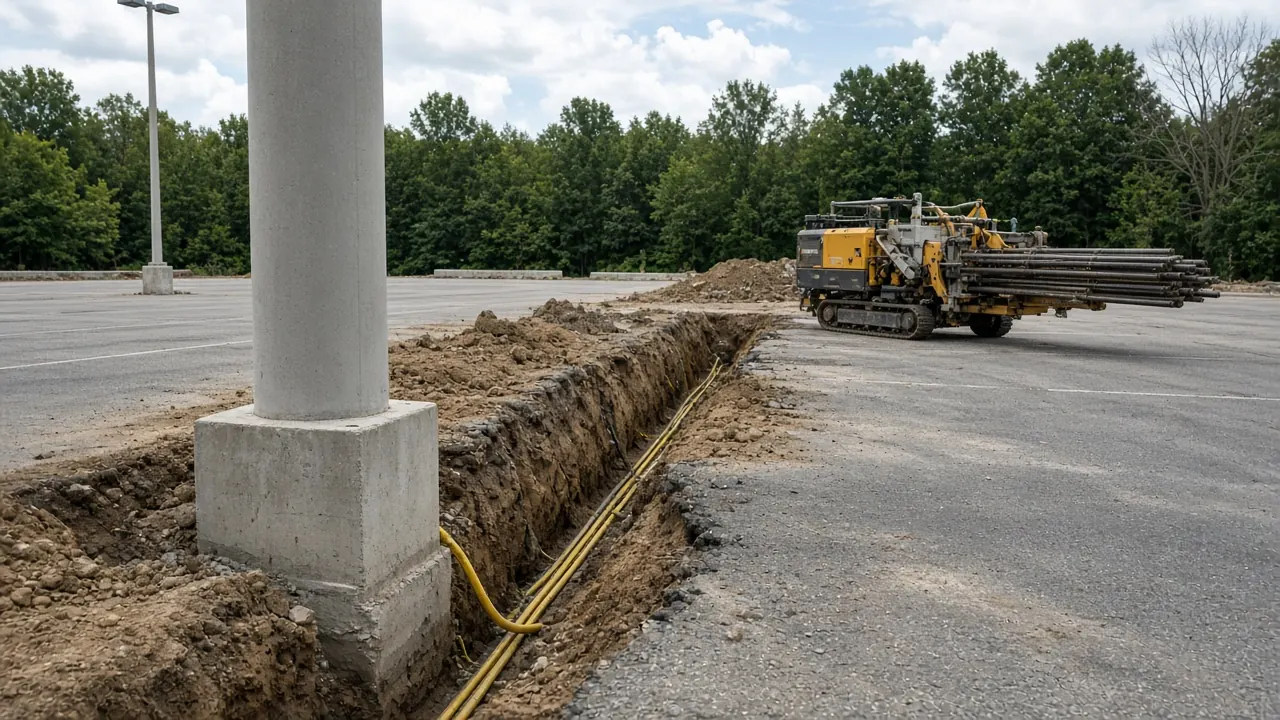
A light pole that worked last month and stays dark now is a common call from parking lots, school sites, and commercial properties around Chicago and the surrounding Illinois suburbs. The lamp and the breaker are the first things people check. When those test fine, the failure is often in the underground conduit that carries the conductors to the pole.
What failed underground
Conduit is the pathway, not the power itself. Water, ground movement, a crushed section under pavement, or a previous cut can break that pathway. The conductors inside short, pull apart, or cannot be replaced because the pipe no longer holds a clear bore. On a lot in Chicago or a suburban site in places such as Orland Park or Naperville, the symptom looks the same: one pole, or a run of poles, will not light.
Digging the whole run with an open trench finds the break, but it also cuts asphalt, concrete, and landscaping that the property still needs. For many lots, the better question is whether a new pathway can be bored from a pit near the source to a pit at the pole.
How directional drilling replaces the pathway
Horizontal directional drilling steers a bore under the surface that is still in use. The crew sets up at the ends of the run, tracks the bore path, and pulls new conduit back through the hole. The parking surface, sidewalk, or drive stays in place except for the small pits. That is the usual approach for underground electrical conduit when a light pole or site circuit has lost its pathway.
If the old conduit is collapsed or full of debris, it is not always worth trying to reuse it. Conduit repair and replacement means a new pipe, sized for the conductors the pole actually needs, with a path the electrician can pull through. A&P Directional Drilling does the underground bore. The electrical connection at the panel and the pole is coordinated with the site's electrician.
What property owners and contractors should confirm
Before anyone drills, the existing utilities have to be located. A light pole circuit can sit near gas, water, fiber, or another electrical run. The bore depth, the entry and exit pits, and the surface the rig needs to sit on all change the plan. A tight island in a retail lot is a different setup than an open yard behind a warehouse.
Contractors bidding the lighting repair should separate the electrical scope from the underground pathway. If the conduit is the failed part, replacing only the lamp head will not bring the pole back. Owners should ask whether the new pathway goes under pavement or through open ground, and how much of the surface will be opened.
When open digging still makes sense
A short, already broken section in grass can be cheaper to open and replace than to mobilize a drill. Long runs under asphalt, a row of poles, or a path that crosses a drive usually favor boring. The comparison is covered in horizontal directional drilling versus open trenching. The right method is the one that restores the pathway without rebuilding the lot around it.
Need a directional drilling or conduit pathway?
Call us or tell us about the project and we will follow up with a free estimate.