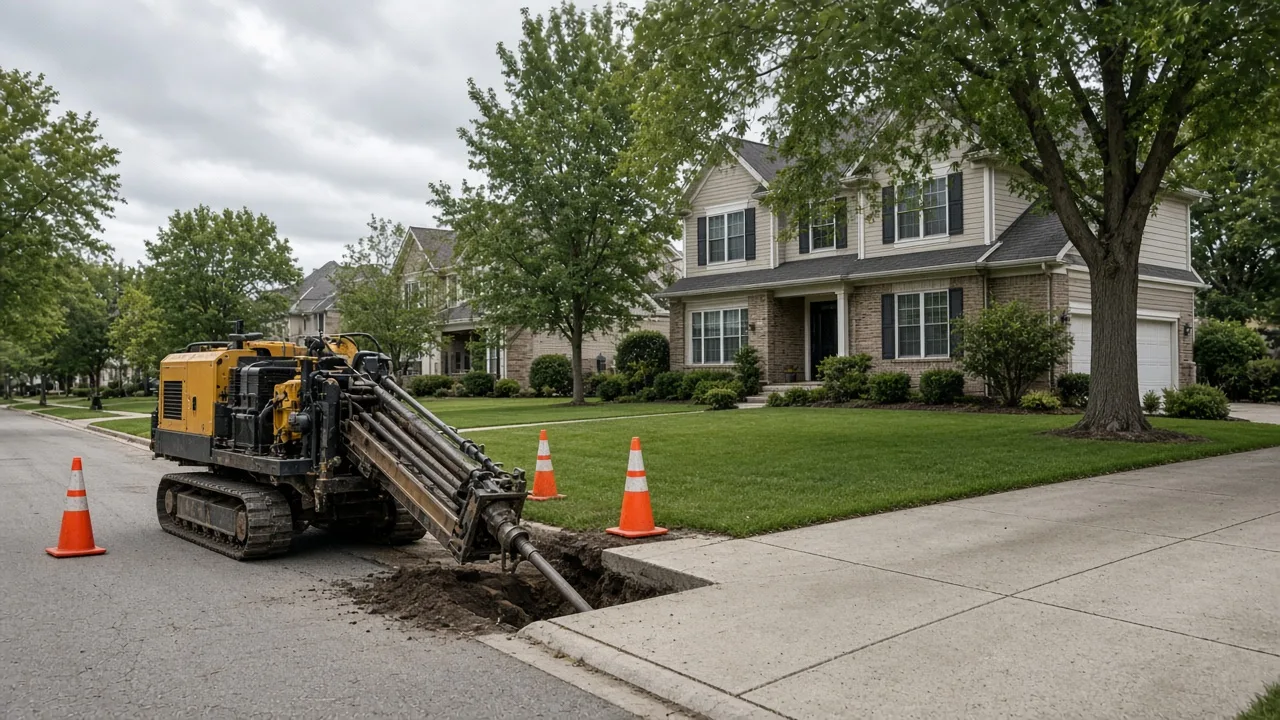
Homeowners and property managers in Naperville often need a utility line to reach the house, a garage, or a yard light without cutting the front of the lot apart. The straight route crosses a concrete driveway, a public sidewalk, a private walkway, or a lawn that is already established. Directional horizontal drilling is the approach used when that crossing can be made from a pit on one side to a pit on the other, so the pavement and the landscaping between those pits stay in place.
When directional horizontal drilling fits a driveway or sidewalk crossing
Power, communications, water, or drainage often has to pass under a surface that is disruptive to rebuild. A concrete or asphalt driveway, a sidewalk along the parkway, a walk from the drive to the door, and planted beds along the front of the house are the usual obstacles. Opening that surface with a trench leaves a patch and a yard that has to be restored.
Directional horizontal drilling fits when there is a workable place for an entry pit and an exit pit, and when the ground between them can take a steered horizontal bore at a depth that clears the pavement and the utilities already in the corridor. A short crossing under a drive or a sidewalk is a common form of under-pavement work. A run that continues through the front lawn can use the same bore, so the grass is not opened from the building to the street.
An open trench still has a place. Where the ground is already bare, the run is short, and restoration is simple, digging can be the practical method. A shallow corridor packed with other lines can also make a bore the wrong tool. Those tradeoffs are covered in horizontal directional drilling versus open trenching.
The bore installs the pathway. Conduit or pipe is what comes back through the hole. Conductors, gas connections, and other tie-ins stay with the trades responsible for that work. A&P Directional Drilling handles the underground pathway on these crossings.
How the crew plans the bore path
Nothing is drilled until existing utilities are located. A frontage in a mature Naperville subdivision can hold gas, water, electric, communications, and drainage in a narrow strip between the sidewalk and the house. Those lines have to be marked, and the new route has to respect the marks.
Private lines often sit outside a standard locate. Irrigation, landscape lighting, an invisible fence, a septic field, or a line a previous owner installed may not appear on the same marks. The owner or manager is usually the person who knows they are there. Pointing them out before the pits are dug keeps the bore path off something the crew cannot see from the curb.
The bore path is the steered route from the entry pit to the exit pit. On a residential lot, one pit is often near the building or the meter, and the other is beyond the sidewalk, in the parkway, or on the far side of the driveway. Pits are where the surface is opened. They are placed so the product can be connected at each end, and so the rods can follow the curve without a sharp bend under the concrete.
Depth belongs in that same plan. The path needs enough cover under the driveway and the sidewalk to leave the pavement structure alone, and it has to stay clear of the utilities that were located. A deeper route needs a longer, gentler curve, and that curve needs room before each pit. If the corridor is too shallow and too crowded, the plan changes to a different alignment, a different pit, or a short open section where the ground is not paved.
Clay, fill, old concrete under a replaced drive, and wet sand each change how the head tracks. The operator adjusts steering, and the bore uses fluid so the path stays where the surface reading says it is. The aim is one continuous route that conduit or pipe can be pulled through.
What the directional bore rig does on the crossing
The directional bore rig sets up at the entry pit and pushes a steerable drill head along the planned route. A transmitter in the head is read from the surface, so the operator can follow depth and direction while the head passes under the driveway and the sidewalk. Those surfaces stay in place.
The first pass is a pilot hole, smaller than the conduit or pipe that will be installed. It proves the route and shows that the exit lands in the pit. As the head advances, the crew adds drill rods at the rig. The machine stays at the entry, which is why the lawn between the pits does not have to be stripped for the length of the run.
At the exit pit, a reamer enlarges the hole. Conduit or pipe is attached and pulled back toward the entry. That pullback leaves one continuous pathway under the drive, the walk, and the lawn. If the product is electrical conduit, an electrician pulls the conductors later. Pipe still needs its tie-in from the trade that owns that work.
The steps are the same ones described in how directional drilling works. On a driveway or sidewalk the run is shorter, so pit location and the curve under the pavement are settled before the rig starts pushing.
Horizontal directional drilling is used for electrical conduit, communication conduit, and similar pathways when the site can take the setup. The rig needs room for the machine, a place to stage rods, and access for the truck. A crossing only as wide as a driveway can still need a clear area beside the entry pit for that equipment.
What homeowners and property managers should prepare for
Walk the route and mark where the line should start and end. Point out sprinkler heads, low-voltage lighting, and any repair already made in the yard or under the drive. Mention a septic system or an older utility fix even if the exact spot is uncertain. The crew can plan around a constraint they have been told about.
Say whether a vehicle has to stay in the garage. The drive may be the setup area, or a pit may sit at its edge. Property managers with more than one entrance should name which drive can hold the equipment and which one residents still need. On a Naperville street the directional bore rig and the support truck share the frontage with neighbors and with people on the sidewalk. If a pit is near that walk, pedestrians still need a way past while it is open.
The opened ground is at the two pits. Between them the driveway, the sidewalk, the walkway, and the lawn stay in place. Drilling fluid is part of a horizontal bore. It is handled at the pits and returns there as the hole is reamed and the product is pulled back.
A&P Directional Drilling provides the bore and the underground pathway. Pulling wire and completing utility connections belong to the electrician or the contractor responsible for that work. Pits are backfilled under the agreed scope.
What to ask horizontal directional drilling contractors
Ask horizontal directional drilling contractors to walk the alignment and answer a few points before a machine is scheduled.
Where will the entry pit and the exit pit sit, and how much ground will be opened at each one? What is being pulled back, conduit or pipe, and who supplies it? Has the bore path been set around the located utilities, and how will the route under the driveway and the sidewalk stay clear of them? Where does the directional bore rig sit, and can a vehicle still use the drive? Who backfills the pits, and who makes the connections at each end?
Ask whether any of the run still has to be dug open. A horizontal bore under the pavement, with a short open section in grass, is a normal plan when one end is tight. If the driveway or the sidewalk has to be saw-cut across its full width, that is open trenching and should be described that way. Directional horizontal drilling is the choice on a finished Naperville frontage when the utility needs to cross and the surfaces between the pits need to stay in place.
Need a directional drilling or conduit pathway?
Call us or tell us about the project and we will follow up with a free estimate.